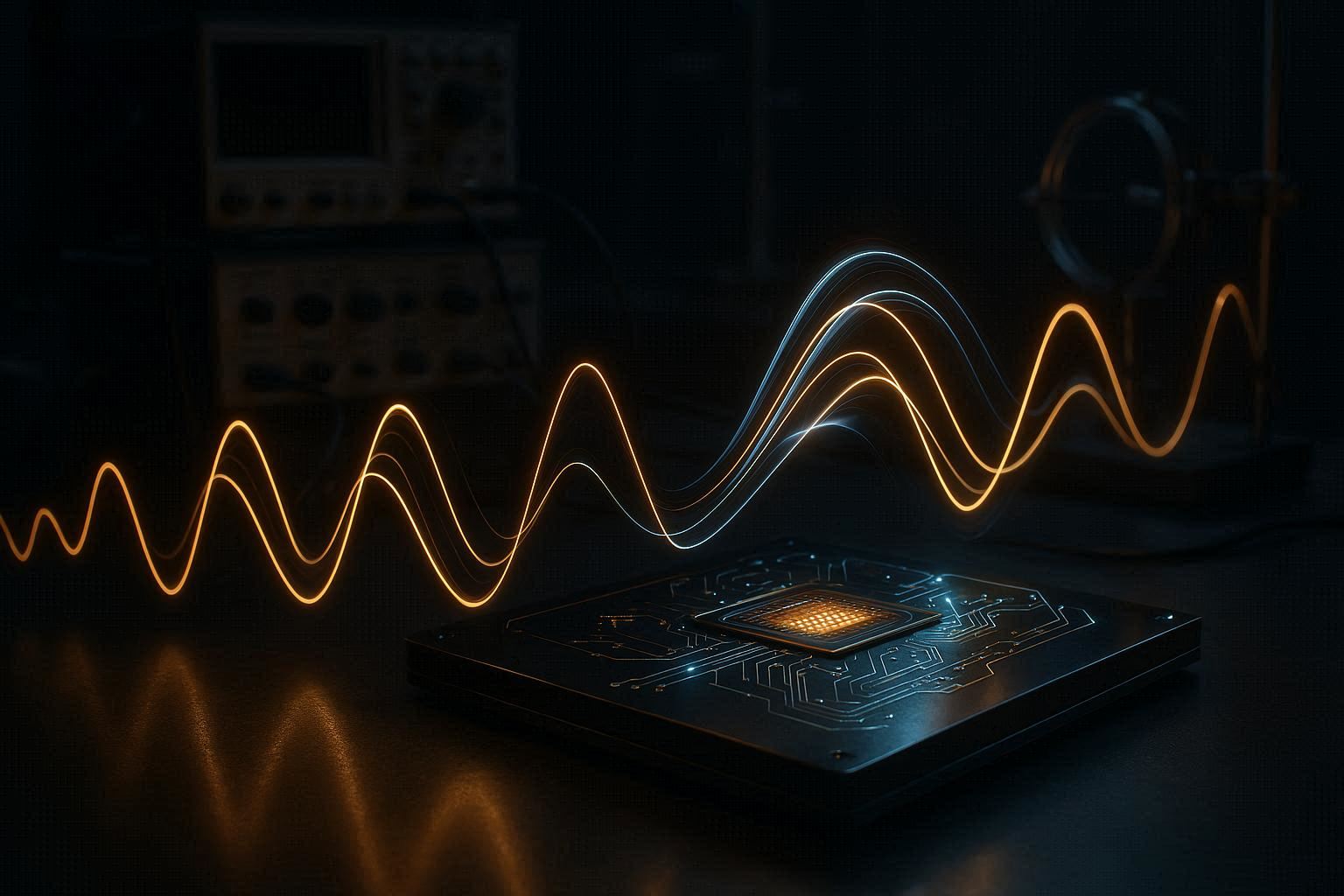
For decades, physicists have speculated about time reflection — a bizarre form of wave behavior that sends portions of a signal backward through time instead of merely bouncing them back in space. After years of theoretical work, researchers have now produced clear experimental evidence confirming the existence of these so-called time mirrors.
This breakthrough is not science fiction; it is the result of carefully engineered laboratory conditions that force waves to retrace their temporal evolution. While this does not equate to reversing time itself for humans or objects, it opens a new frontier in wave control, signal engineering, and photonics.
What Are Time Mirrors?
Imagine looking into a mirror, but instead of seeing your reflection turned left-for-right, you see your past actions replayed in reverse. That’s a rough analogy for how time mirrors work: instead of light or electromagnetic waves reflecting spatially (like off a glass surface), they can be made to reflect temporally — reversing direction in time.
These effects arise when a wave encounters a sudden, uniform change in the properties of its medium. When scientists precisely change the environment of a wave very quickly, part of that wave can shift direction and travel backward through time, in the sense that its evolution follows the reverse of its original temporal sequence.
This phenomenon was first theorized more than half a century ago, but until recently it had never been observed with clarity. The new results confirm that time reflection is a real, measurable event in physical systems.
How the Experiment Worked
To demonstrate time mirrors, researchers used a specially designed metamaterial — an engineered structure that interacts with electromagnetic waves in ways natural materials do not. By rapidly changing the metamaterial’s properties using electronic switches and capacitor banks, they created what scientists call a temporal boundary.
When an electromagnetic wave encounters this abrupt change, part of its signal reflects backward in time. Instead of bouncing back in space like a normal mirror reflection, the wave’s final portion appears first, followed by earlier parts of the original wave — essentially a time-reversed copy.
These experiments used accessible technology and careful synchronization, proving that time mirrors can be triggered in a controlled laboratory environment, not just in theory.
Why It Matters
This discovery has multiple implications for science and technology:
-
Wave control and communications: Reversing waves in time could lead to new techniques for filtering, routing, or engineering signals across the spectrum. The time-reversed waves can also translate frequency, potentially aiding in communications and adaptive filters.
-
New physics tools: Time mirrors add to the tools physicists can use to study complex systems, including optical, mechanical, and potentially even quantum waves.
-
Signal processing advancements: Systems that manipulate wave behavior in time can inspire innovative technologies in computing, imaging, and sensing.
Importantly, this does not mean time travel for matter or people is possible. Instead, it is a revelation about how waves propagate and how human-engineered environments can shape that propagation.
What This Does Not Mean
A common misunderstanding is that this experiment bends the fabric of time itself or enables messages to be sent into the past. It does not. The time-reversed waves are confined to the controlled setup created by researchers. Time outside this environment continues moving forward as usual.
FAQs
Here are answers to common questions scientists and curious readers are asking:
Q: Are time mirrors the same as time travel?
A: No. Time mirrors affect how waves propagate within a material or system. They do not reverse the flow of time for objects or people.
Q: What kinds of waves can be time reversed?
A: So far, electromagnetic waves have been shown to reflect backward in time using engineered materials. Future research may explore other wave types, like acoustic or mechanical waves.
Q: Does this discovery change how physics works?
A: It confirms a long-standing prediction in wave physics and expands our ability to control waves, but it does not upend fundamental laws like causality or relativity.