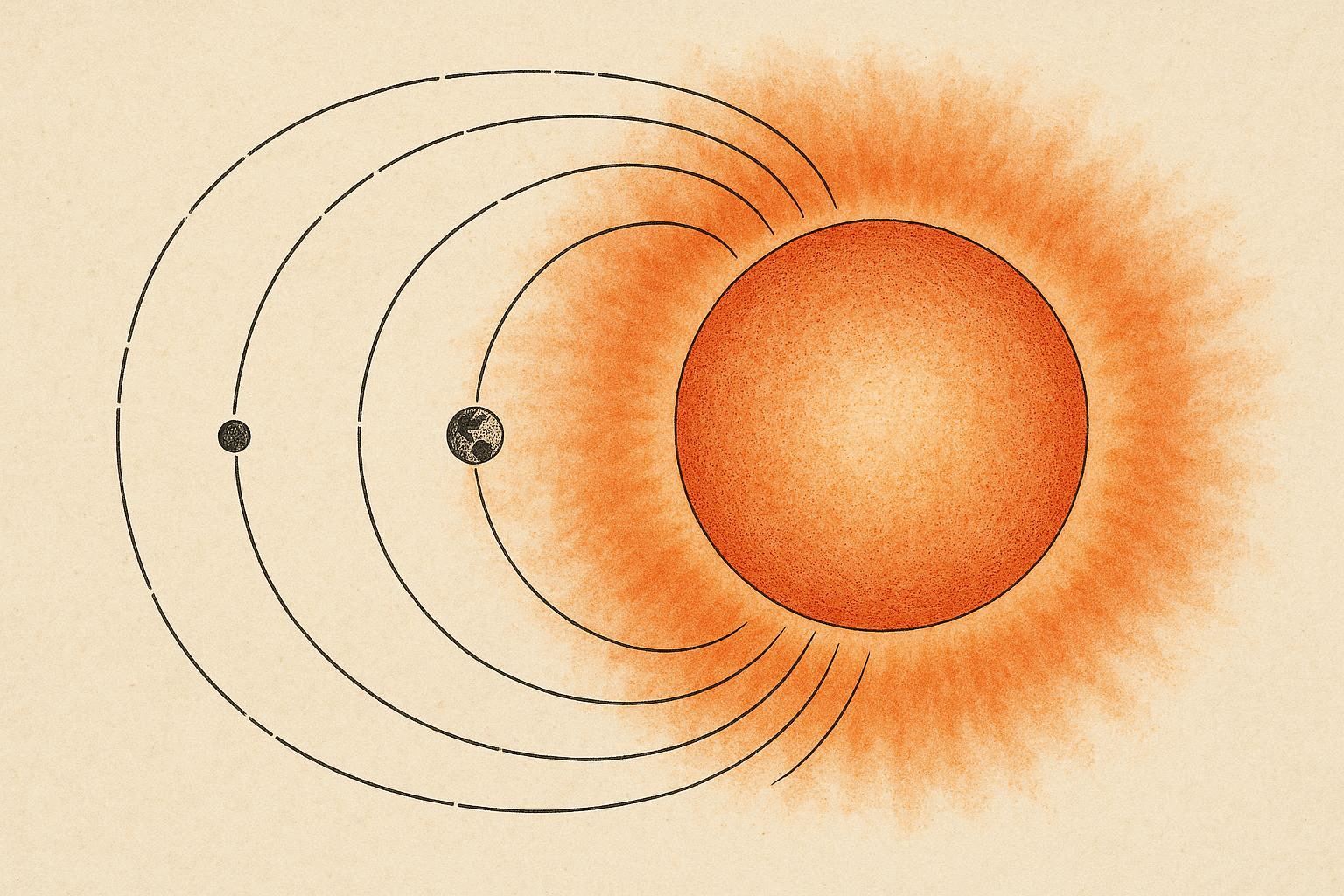
Scientists say Earth’s existence is finite and ultimately tied to the life cycle of stars. As stars like our Sun age and exhaust their fuel, they expand and change dramatically. Observations of other star systems show that aging stars can literally “eat” nearby planets, offering a glimpse into what could eventually happen to Earth.
Astronomers analyzing thousands of stars have found that many close-orbiting planets disappear as their host stars evolve past the main sequence. This suggests planets either spiral inward or get engulfed as stars expand into red giants — a process that may foreshadow Earth’s distant future when the Sun reaches its red giant stage billions of years from now.
Why Stars Eat Planets
Stars spend most of their lives fusing hydrogen in their cores in a phase known as the main sequence. When that hydrogen runs out, the core contracts and the outer layers expand dramatically. This transition into a red giant can stretch the star’s size to hundreds of times its original radius.
As these outer layers balloon outward, tidal forces and intense heat can drag nearby planets inward or vaporize them entirely. Scientists see fewer close-in planets around aged stars compared with younger ones, a pattern consistent with planetary destruction over time.
WASP-12b — an exoplanet much larger than Jupiter — is one example of a world losing mass and gradually spiraling toward its host star, where it is expected to be consumed long before the star’s red giant peak.
What This Means for Earth
Our Sun will eventually follow the same natural progression. In about 5 billion years, it will deplete its core hydrogen and expand into a red giant, possibly engulfing the inner planets.
Two possible futures emerge from current models:
Engulfment: The Sun’s expansion could reach Earth’s orbit and literally absorb the planet. This is the classic “planet-eating star” scenario.
Extreme heating: Even if Earth isn’t engulfed, the vastly increased heat would boil away oceans, destroy the atmosphere, and make the planet uninhabitable long before physical contact with the Sun.
Either way, long before this final fate, Earth will cease to be a hospitable world as stellar evolution and solar warming intensify.
What Observations Teach Us
Astronomers have gathered evidence by studying stars at different evolutionary stages:
Surveys of tens of thousands of older stars show a marked absence of close-in planets, interpreted as signs that these planets were destroyed.
Telescope data from missions like NASA’s TESS supports tidal interactions causing orbital decay that ultimately leads planets toward their stars.
Observations of star-planet interactions offer real, observable examples of planets being drawn into their stars before red giant expansion completes.
These insights help scientists refine models of stellar evolution and planetary fate across the galaxy.
Broader Cosmic Context
Stars of different masses experience death differently. Massive stars may explode as supernovae, scattering heavy elements and triggering cosmic effects, including impacts on nearby planets (though not directly swallowing them in the red giant sense).
For stars like the Sun, the life cycle ends with a white dwarf after the red giant phase, leaving behind dense cores that slowly cool over billions of years.